Tuesday, November 11, 2008

Swallowability


There is a trend I hate (ok, one of many) that has developed in hour-long evening TV dramas. First you must understand that we are in a post-CSI world: Science rules, Romance drools (although staggered bits of Romance do provide for fluffy insulation between layers of Science). In attempts to get the older, hip, wise “cause they’ve seen fire and they’ve seen rain” 50-something people to watch, the producers will incorporate a soundtrack of Beatles, Bowie, CCR, and Crosby Stills Nash—except, they’re all covers. Because the originals are too expensive and difficult to obtain. And the younger, fresher, cheaper artist never does the song justice. S/he always sounds like the flaccid whispering voice of today’s adult-contemporary; an underlying pulse of vocal cords that seem afraid to feel out its own chest cavity for fear of...what? Seeming immature and less wise, old, and fire-n-rained out?

I blame this on Cat Power.
Photobucket Photobucket


That bitch. Correct me if I’m wrong, but she very well could have initiated this whole movement. Her Covers record (2000) could have been the inspiration for Across the Universe, that 2007 film written around the Beatles’ music using only covers of their songs (all sung by the film’s own actors, no less). But you know what? I take it all back. Good for her. She opened up a huge market for medium-talented vocal music majors all around the world—not only can they stop worrying about having to write their own music, but they don’t even have to find a record company that will! Just start singing other peoples’ songs from the get-go! Take your karaoke habit and make some money off it. Those 50-something fired-n-rained middle classers will appreciate your innocent renditions of the songs they used to fuck to.

For the life of us, let us not think about what “covers” could be covering up.

And what goes on the shows while these covers are playing? The usual sentimental bullshit. Slow motion scenes, black-and-white flashbacks, reluctant tears sneaking out of some old man’s ducts...as long as the motion is slow and drawn-out, it will make a meaningful montage for any Carol King or James Taylor selection.

Think about the outlets that are created by shows like “Without a Trace,” “Cold Case,” “CSI,” etc. What are the recurring themes?
1. Science always paves the way for Justice (and Technology speeds it up)
2. Single, emotionally damaged people find meaning in their working relationships
3. Popular, familiar music from the 60s and 70s gives the New World Evil (child molestation, serial killing, etc.) a sense of history, clarity, and swallowability

Tuesday, September 30, 2008

I'm a voyeur, you're a voyeur...

I have been following the Dresden Dolls for a few years now and reading Amanda Palmer's blogs...which has made me feel voyeuristic, envious, and pathetic; sometimes each of those feelings occurring, in turn, during the course of one blog. But as a result of keeping up with her blogging, I've been able to witness the development of her solo album over the past few years, and her thoughts about it, and her digital camera snapshots of various phases. With the release of her videos on Youtube, I've found that most of her songs don't disappoint (the ones I don't like are just too sappy for me).

One song I can't get enough of is "Runs in the Family," which harkens back to "Girl Anachronism" with its run-on lyrics and subject matter of mental disarray. The video shows her simply losing it front of the camera, right in the middle of her messy apartment -- nothing new. But as usual, her rhymic timing and close-to-home lyrics have me feeling helpless to the music, and a voyeur once again.


"Astronaut" is good too, but you have to wait for the chorus to realize that the dramatic first verse is worth it.

"Guitar Hero" is worth a listen for its lyrics, but not necessarily its musical development.

Sunday, September 28, 2008

Monday, August 18, 2008

The Paranormal: Mere Nostalgia


“Why are people so eager to accept flimsy and fabricated evidence in support of unlikely and even outlandish creatures and ideas? Why is the paranormal realm, from psychic predictions to UFO sightings, so alluring to so many?”

This is a quote from an article I read today. A psychology professor at Missouri Western State University, interviewed by writer Robert Roy Britt, responded with “it is an artifact of our brain’s desire to find cause and effect.”

On a related note, I believe that to admit to any belief (or non-belief) is to submit to a subjectivity. If I’m alone and my neck hairs start to prickle because the air suddenly seems different, I am more than likely to remind myself that I don’t believe in ghosts, only memory. I love this idea. Here is a relevant quote from Henri Bergson’s Matter and Memory, published in the early twentieth century:

By the very constitution of our nervous system, we are beings in whom present impressions find their way to appropriate movements: if it so happens that former images can just as well be prolonged in these movements, they take advantage of the opportunity to slip into the actual perception and get themselves adopted by it…So we may say that the movements which bring about mechanical recognition hinder in one way, and encourage in another, recognition by images…But, just because the disappearance of former images is due to their inhibition by our present attitude, those whose shape might fit into this attitude encounter less resistance than the others; if, then, any one of them is indeed able to overcome the obstacle, it is the image most similar to the present perception that will actually do so.

I admit that I haven’t finished the book; I am a slow reader when it comes to philosophy. But this idea that images from former memories can infiltrate the present perception and inspire recognition within the subject…I sort of touched on this idea in an earlier blog, but I didn’t go too far with it. I bet that, along with the MO psychology professor’s opinion about the desire for cause and effect, people’s memory mechanisms can be blamed for every recorded instance of the paranormal.

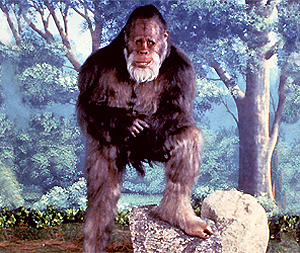
For example, I’m sure you caught the photo on the news of the Bigfoot slumped over in a deep freezer. Didn’t it look exactly as you want a Bigfoot to look? Somebody may as well have stolen a costume from that horrible 1987 movie starring John Lithgow. We all have a Bigfoot Standard Image in our minds. We have one for the Loch Ness Monster, one for Jesus, and one for Miss America. In my opinion, we may see objects in real life, but former images (as in the Bergson quote) sneak in and lay all over our perception, in the way that my grandma placed a sheet over the couch when the grandkids were visiting.

Back to what I hinted at earlier – any belief submits to subjectivity. I may not believe in ghosts, but even in this non-belief, I am throwing sensory information, what I’ve seen of silly reality TV shows, what I’ve read of literature, and my ghostless childhood, all into a consciousness processor. A conscioussor (that is horrible). My non-belief is as arbitrary as that of the Texan woman (in the above-cited article) who thought some mangy dog was Chupacabra!

Thursday, August 14, 2008

A poem


The Job Search, or "Vacant Chess Board"

Days and days like
black white black white

then

a phone call,

the interview,

a “waiting” move met
by self-doubt
threatening checkmate

Monday, August 11, 2008

Did oceanside vegans exist before mass production?

Lately I have stumbled across a lot of vegan literature. I have one friend who is a confirmed vegan, and another who is vegetarian. Many artists I admire also claim to shun food derived from animals.

Today I got an email from Saul Williams (no...not to me personally...I'm just on the list) that spent a lot of time discussing the use of "List of Demands" in the Nike campaign, the responsibility we have as Americans, and veganism, respectively. While he says many good things about his Nike decision, and many good things about our American duty to the world (check out this quote: "The idea that might is right, that we demonstrate our power with aggressive force is great for football teams, but hardly the best idea for a country whose running source of pride has historically been the evidence of our collective imagination: our music; our films; our amusement parks; and the technology we create to share it"), what I would like to focus on are his statements about eating animals. I've pasted a good chunk of it not because I agree, necessarily, but because I enjoy his writing:

I am sometimes hesitant about making a big deal about my vegan diet, as I have considered it a personal choice worth little discussion. Yet more and more, I have found myself attempting to encourage people who ask me where I find my inspiration, or what issues do I find important, or how can we curb warfare and violence to consider what we ingest. A story was recently recounted to me of a popular TV chef who chose to raise little piglets on his show to insure that they were fed organic food and not injected with chemicals (as is the practice on most factory farms), all for the sake of fattening them up for their slaughter and another primetime recipe. Yet, the time that this chef spent with these pigs taught him a valuable lesson (more valuable for the pigs, no doubt). What he learned was how intelligent pigs are. In fact, in recent times, it is common knowledge for most that pigs are arguably more intelligent than "mans best friend" and companion, the dog. For our chef, this meant switching gears and realizing that he could not consciously kill this intelligent animal, that it would constitute a murder as brutal as slicing your fluffy pets neck and watching it writhe and bleed to death, or sticking an electric prod up its ass and electrocuting it, if the fur or skin is of value…

It may seem like I have just taken a turn to the graphically extreme, I wouldn't want to make you "lose your lunch", but these are the common practices perpetuated by the factory farm industry on millions of animals a day, in the name of your breakfast lunch and dinner. And, no, I'm not simply talking about pigs, but also cows, chickens, turkey, horses (that's right horses. Everyday), and fish. Everyday, our species participates in the mass genocide of other species without care or concern or even questioning whether the violence that we ingest and condone plays any role in our apathetic support of the war machine we have become. How is it that we as human beings can represent both the highest and most developed and lowest and least concerned forms of intelligence of any living species? Are we simply glued to age-old barbaric traditions that cloud our senses and render us inhumane in our dependence on comfort foods and practices? Is our dependence on foreign oil the only thing we need to curb? What about not so foreign species?

Some might argue that artists are a race or species apart from the common person. Yet we all identify with the teachings of Gandhi, the genius of Einstein, the art of Leonardo Da Vinci, Picasso, Rembrandt and the talent and compassion of living artists like Alice Walker, Will Smith, The Mars Volta, Dead Prez, Prince and countless others. Some of us choose to emulate their styles, their fashion, their career choices, but why not their diets? If our brightest most celebrated stars all have this one thing in common why are we so slow in connecting the dots for ourselves? Perhaps the biggest issue at hand is not what our cars run on, but essentially what do we run on? The fact is that factory farms are the number one users of crude oil, not cars. That's basically what it takes to kill approximately one million chickens per hour (just in the US). More than half of our water supply goes to feed animals being fattened for slaughter. The methane gases that contribute to global warming are produced majorly by cow farts in factory farms, not to mention the amount of fossil fuels needed to create just one pound of beef.

Yep. You doing the math? Basically if we shifted our compassion towards animals, the domino effect would heal the planet. We'd no longer be cutting down rain forests to create more space for cows to graze, we'd stop depleting the ocean of the necessary (keyword: necessary) food chains that our eco system depends on, diseases including many cancers, heart disease, obesity, and others which find their root in the food/toxins we ingest would slowly disappear as would our taste for violence.

Alright, so the last bit about diminishing our taste for violence is way utopian, but he makes good points. My response to animal rights activists was always, "What were the Inuits going to survive on, snow and seaweed?" But this argument doesn't hold very well, since the Inuits make up a small percentage of the world population, and most people these days have access to plant-based food.

So here's a better argument: Why aren't poor people vegetarian or vegan? The answer is obvious. Even if they could afford the lifestyle, it's doubtful that most of them have enough time or energy to fix themselves (and their families) soy-based food. It's true that a lot of poor people in some African and Asian countries are traditionally vegetarian or vegan, but they are also farmers and have ready access to vegetables. Your average poor American lives in an apartment, works most of the day, and doesn't have the willpower to find (and pay for) the grocery store. As a result, the survey says that being vegetarian or vegan is directly related to being white, educated, and somewhat wealthy.

A few weeks ago, I saw that the mayor of Los Angeles placed a ban on any new fast food restaurant entering the east side of the city. A short interview on CNN showed a local woman saying, "There is no whole foods here. We have no Trader Joe's. I have to drive through traffic to the other side to get fresh produce." There you have it.

I am in complete agreement that conditions need to be changed for the animals who are queued up for slaughter. I'm also in agreement that the drive for meat production places an enormous stress on the environment. But trying to convince omnivores that they're participating in murder ain't gonna do shit, because they don't care. Sad but true. Similarly, the small percentage of educated white vegans isn't going to clear the air of cow farts and factory pollution. I think the only chance animal rights activists have is to create public awareness that centers on the effects of meat on the body and the earth. Maintain a "selfish" campaign, and learn from politicians: Talk only of the issues people are concerned about -- their blood test results and their grandchildren's air quality (although even this is debatable).

Despite all this, I do love Saul Williams, and he just came out with a music video for "Convict Colony" (which was the real reason for the e-mail; don't you love muddled motivation?)

Thursday, August 7, 2008

Cartoon Torture


Some “artist,” named Steve Powers, says he built the Waterboarding Thrill Ride to criticize waterboarding.

Waterboarding an attraction at New York amusement park

Curious people can feed a dollar to a machine and peer through a window to see a robotic SpongeBob SquarePants tied down, saying, “It doesn’t Gitmo better!”

I highly doubt that Steve Powers is going to get his point across with a cartoon character at Coney Island. If anything, he is allowing people to distance themselves from the act of torture (re: cartoon characters in an amusement park versus the actual tortured people in the actual Guantanamo Bay facility), thereby taking waterboarding (which becomes a symbol for all torture, since it’s the only technique in the news) less seriously.

For example, Theodor Adorno, a music sociologist and philosopher, spoke out against war protest songs in the 1960s because he claimed it made the horrors of war more tolerable. And when you consider how War becomes a generational marker (my father was in the navy during Vietnam, my grandpa was a bomb-diffuser in WWII, etc.) then any anti-war movement also becomes a chapter in one’s life yearbook.

When I think of artists using cartoon figures, I think of Ron English’s billboard paintings a decade or so ago. He used McDonald’s cartoons, Disney characters, and other cartoonish figures to send a message about injustices and addictions that feed big business. He also staged live performances, such as having a woman get a make-believe abortion with a clothes hanger and bleeding all over a billboard, in front of a crowd of people. How are his methods different from Steve Powers’? Did English’s efforts make the horrors of pro-life rhetoric, big tobacco companies, and fast food addiction any less serious? Not in my mind. Since Powers built this “attraction” in an actual amusement park, the Waterboard Thrill Ride is part of Coney Island. On the contrary, English risked getting arrested every time he took over a billboard. Powers is actually making money off of this “ride.”

So Steve Powers is not really speaking out against Guantanamo Bay or the torture of prisoners. He’s not risking anything. Instead, I believe he is securing his place in the anti-war yearbook and making some money at the same time. What’s worse, his work may actually result in opposite effects from what he intended, distancing people from what is going on every day, even more.

Friday, August 1, 2008

Unnecessary Inquiries


I’m convinced that one of these is more accurate than the other:

1. Male humans dominate the world.

2. Male humans dominate the face of the world.

3. No, female humans dominate males, who then believe the males are the ones dominating the world, when females are really dominating.

4. Both dominate the world on equal terms, but female domination is shown mostly through the domination of physical aesthetic and familial relations.

(The word “humans” is the real problem; it’s not a question of gender superiority, but a question of action.)

(Everyone commits action; it’s more a question of acceptance.)

5. The acceptance of male action dominates the world.

I vote for #5.

Thursday, July 31, 2008

Real Skeptics


Everyone calls herself a skeptic, but it seems that it’s never long before you discover the silly ideas that person holds, despite her self-proclaimed skepticism.

I call myself a skeptic, but I’ll admit that I still hold ridiculous ideas. Here’s one: I believe that containers, such as rooms or desk drawers, can soak up “bad energy” and even retain it. This naĂ¯ve belief goes further – I think it’s possible for an innocent party, unbeknownst to them, to feel the effects of this bad energy and even be influenced by it. Right now you may be thinking, “Define bad, define energy, and give me a real-case scenario.” This is what I would do if I were reading this, because I am a skeptic. But I have no definitions, I have no real-case scenarios. I just think it’s possible. I’m also more than willing to admit that it probably isn’t true, but what if it is…

It's also possible that the hypothetical party feeling these bad energies could just be associating certain colors, smells, sounds, etc. with unpleasant memories, unwittingly inflicting the bad vibes upon themselves. This theory seems to be the most probable, although much more un-fun.

Anyway. Here is one thing I’m skeptical about:

“Bottled Water Sold in the Heartland Benefits African Children”

Quote: “[New business owners Justin Pobst and Eric Becking] hope to use all proceeds to benefit children in Africa. The two say clean water is a basic necessity many children do not have.”

The obvious question is, why not send all that bottled water to Africa? Don’t they know by now that most people around here don’t give a shit about starving and/or dehydrated children? And besides, who wants to buy bottled water at a bank?

But I can see the benefits. Transporting bottled water (and accommodating its poundage) across the Atlantic uses a lot of gas, = more money. And once the bottles are gone, they’re gone, opposed to collecting funds to build wells which will last a while. I hope the organization gets enough money to balance out the cost. Maybe people will be smart and donate without taking the bottle of water. That’s a lot of plastic.

It’s funny that senseless buying habits (such as millions of people buying brand new bottles of water every day) are more tolerable to the conscience (because they’re unorganized) than a charity selling bottles of water to raise money for a good cause.

“Charities, you can raise money for your good cause, but make sure it’s economically/environmentally practical or I won’t donate! General public, you silly hedonists, you use too much plastic, you should probably stop.”

Speaking of hedonists, Exxon has a record profit again on soaring oil prices and Shell profits gush. Readers, take heart. Know that some people’s penchant for SUVs and Hummers is feeding corporate America, and this is why they get tax breaks.

Wednesday, July 30, 2008

Obama is Batman

For about five months now, I've been getting free issues of Rolling Stone and Entertainment Weekly in the mail. I have a theory that either my credit card company or my university sold my address, but I have no evidence to support this (other than the fact that I started getting them shortly after I applied for my final round of student loans).


"I can't wait to get another free magazine with Obama or Batman on the cover."

This is what I caught myself saying yesterday evening. Think about it. Obama is Batman:
1. He wants to do good for the public, but he's got a dark past.
2. He's attractive, muscular, and well-spoken.
3. He arrived on the media scene out of nowhere, getting elected to the Senate only four years ago, surprising everyone.
4. The media is infatuated with him.

Now, it's true that the media is not making this connection directly. There is no babble on CNN about Obama having superpowers (although to watch Katie Couric's worshipful interviews with him is nauseating; when he answered her questions in the Middle East I thought she was about to offer a sacrifice up to him), he isn't out to get revenge for a loved one's death, and he can't fly.

But. Like all politicians, he must have two identities -- one for the camera, one for closed-door meetings. He isn't white, which gives him an overall darker visage, especially in the eyes of white people. Batman refuses to kill, and Obama (as it appears) refuses to participate in dirty politics.

Think about film theory, and the historical parallels of escapist film during times of war (ex: Rogers and Hammerstein during WWII). If we can assign societal context to commercial blockbusters (and I do this often; take for example the new X-Files’ showing of a light, shiny, disinfected stem-cell operation in contrast with an illegal, barbaric, full head transplant) then Batman is the youthful, honest, hard-working hope of America. Too bad it’s just entertainment.

Monday, July 28, 2008

Abstorisms

Ignore:
All urges to make your daily experience “timeless” in some attempt to negate the mundane.

Welcome:
All metaphors, both stupid and far-fetched.

Always Be:
Cryptic whenever you feel it.

See Also:
That summer, when time did that clichĂ© thing and “stopped” and there seemed to be no way to keep us from getting our wheelbarrows into that rut, you know, with the beer, the food, etc. That crappy 3 a.m. feeling, when you have 4 entire hours to be awake before the alarm goes off, before you find yourself on the boat at work: Hey guys, sorry if I’m acting strange, but are we moving? I can’t seem to shake the feeling that we’re moving. Is it just me? Now it all makes sense. Every setting feels the same, at-work-in-the-bathroom-buying-groceries, happening all at the same time, because you’re still on the goddamned boat. It was the summer that never stopped floating out into the middle of the lake. Shouldn’t we put an anchor down? It’s going to take a while to get back.

Sometimes:
It is rewarding to speak in a wretched kind of dirty, abstract language. You never know, you could find that a cult is following you, even in your most giddy 4 a.m. moments. They’ll jot down the abstract aphorisms (abstorisms) that fall from your lips just as the valerian root starts to soften your tongue.

Unfortunately:
Sooner rather than later the cult will disperse.

Because:
It will begin to rain, they’ll get hungry, your wit will hath runneth out & over the bathtub “of their minds.”

Oh well:
It was a good run. Amused yourself and others, so god bless American.

There is a snowflake stamp on my hand

Written October 23, 2006


It was a rainy Saturday night and maybe that helped inspire the inspiration brought on by the Dresden Dolls. Maybe it didn't, but the eye pencil on my cheek a la Clockwork Orange didn't have a chance to smear.


Uncle Ho and I stopped into the Halo bar for an expensive drink and a smoke. Mine was a Long Island iced tea, his was a Bud. The Cardinals game was on, but we were none-the-wiser, the Dresden Dolls weren't even a mile away, like-minded individuals were filling up the Pageant like mold fills up a year-old container of fudge brownies. I had never been so excited to be moldy. We survived the "security check" (laughter, applause) thank you, yes, we survived it pretty good, although I think the lady shining the flashlight into my purse didn't appreciate the brickabrack that was obviously planted to hide my coke stash.


We walked in and our ears immediately caught a morbid, frenzied harmonica being played into the microphone. A white man with a fro, named Sxip, was blowing the audience's assholes away. He finished the harmonica, then put coins into a glass bowl and kept them spinning in a cacophonous rhythm which accompanied his singing and breathing, rhythmic and in tune with the pitch pedal at his feet. I looked over at Uncle Ho and grinned. He didn't grin back because his eyes were stuck to the stage; almost everyone's were. Not to speak of the average-looking youth chattering at the bar; they will never go away. Sxip introduced the opening band, The Red Paintings.


People flooded the stage; there were grunts, a bass player dressed as a geisha, another geisha with a violin, two naked girls covered in grayish paint, two more girls setting up blank canvases at the back of the stage, and yet two MORE girls with paint cans towards the front. The singer walked out wearing a long green fuzzy coat, much like the one found on their web page. The band began to play, and the two girls in the back began to paint! Long, black strokes, then red, brush brush brush, quick and passionate, their torsos moving with the music. The two painted naked ladies stood on either side of the stage, one wearing a large fan-type headdress, perched in a statue-esque posture as two other girls painted on their bodies. As the violin geisha played, I could see that the instrument was luminescent and electric, adding gorgeous tones to the lead guitar and bass, a spooky afterthought, a traditional-sounding voice in the midst of the rocking. The four girls were painting, the painted statues were dancing, the geishas were swaying in their dresses, the drummer's kabuki mask held tight, the lead singer was…on something. Yes, he was intoxicated; during the set he knocked over a microphone stand, got chords tangled up in his (impractical) lime green coat, and then came the last song. "The Revolution is Never Coming." I looked at Uncle Ho and laughed, nodded. Great music, very interesting, very different, although the singer sounded like he was doing a good Brian Molko impression (lead singer of Placebo). The song was winding up, or winding down, winding louder and faster and the singer was spinning, oh god he's going to hit something or someone, a painted statue almost got a headstock in the mouth, this is bad…he fell of the stage. Yep. Five or six-foot drop? The bass geisha quickly disrobed the instrument and gown and bent down to check on him, the band stopped, the drummer stood up, the girls stopped painting, security guards have arrived on the stage. The set was over, whether it was supposed to be or not.


I was thrilled. Of course the singer was alright! People fall off stages all the time; look at that politician that fell off the stage. Or was it an actor? Like there's a difference. Sxip came back out and warned the audience that the show was NOT over; he was going to play another song and we were to welcome a St. Louis-based performing group called Gravity Plays Favorites. They were fucking amazing, and completely hot.


After the left the audience good and wet, the Dresden Dolls took the stage. Poor Amanda was losing her voice, but she kept on and we were none the wiser. These guys are amazing because they act like people, not rock stars. Some of the girls from the Paintings were to the right of the stage, creating another canvas in rhythm with the music. A visual representation of art inspiring other art. The Dolls played music from both albums, including my favorites.


Uncle Ho put it best: "I came to the show with a crush on Amanda and left with a crush on the drummer." Brian Viglione knows what it means to perform. He was as much a part of the show as everything else. He gestured, he flailed, he stood, and at one point he played both acoustic guitar and tophat. His devilock was an extension of his brain. There was so much energy and charisma. The Dolls did "Mein Herr" which was hilarious, they premiered a new song called "Lonesome Organist Rapes Page Turner" and did a kickass cover of "War Pigs." They left after "Girl Anachronism" but came back because the audience wouldn't stop whooping hollering clapping stomping screaming MORE! They came out, played "Mad World" from Donnie Darko (which I still haven't seen) with the recovered lead singer of Red Paintings, apparantely named Trashed McSweeney.? That was good. They ended with "Half-Jack" and left, for good.


Uncle Ho and I left warm-hearted and inspired. An amazing show. I would see any one of those acts again. Best $17.50 I ever spent.

"Mein Herr" on-stage at the Pageant

Monkeys, knowledge, and real stories

Written Feb. 1, 2007

It's been a few weeks since I've written a blog. I'd like to blame it on winter, for taking too long in birthing summer. Like a hapless father-to-be in the labor room, I'm waiting for the miracle to present before I light my cigar.

But winter's not the problem, and it never was.

I'd like to blame it on school, my two literature classes and my research class.

I'd like to blame it on "but if I'm writing it should be writing on my thesis or music."

That's not it, either. If there's one thing I love, it's Procrastination in the name of Communication.

In truth, I think my monkey is soaking up most of my humor. I keep trying to give the fucker some bananas or nuts or something, but he won't take it. Course, I'm not making a real effort to chase him off. Guess I can't blame the monkey, either.

Well. What have we now? What is always left until death: Desire. Doesn't matter how much I want to feel occupied, satisfied, appreciated, important, interested, connected, like my ideal I; doesn't matter how much I want to enjoy life. Wanting something isn't getting something. This is something I've learned within the past month, with thoughts thrown back to my father: plans are not actions, your mind's image of yourself is not yourself. I will never be completely connected with who I am. I will always be in a conversation with myself, but with earplugs. An objective portrayal of myself doesn't exist, no matter whose opinion I seek out. And this is why it is so laborious to convince people that they are people, that their problems are valid. If I were to point to a root of insecurity (which I think is not trusting your own self), I would say the problem is with wanting to know why. Whys reward you with 20 degree temperatures of the mind, where all processes are frozen and sound streams through like aurora borealis and it's vivid in the sky, but you're just as far away as you thought you were. Whys are dog shit, and it sucks to track it into someone's house or conversation. Of course I am guilty. When you're cold, you want to be around others who are warm.

I've been thinking a lot about knowledge lately, and what it is to have knowledge -- certainly, it corrupts the natural order of the mind, like every other kind of input rampant in society. All my brother's good stories are commercials he's seen which he thinks are funny. That is sad enough to drink over -- he doesn't have real knowledge, or even real stories. What is real knowledge? Book learning? Schooling? Observation? Maybe all of these things. But knowledge isn't all there is; many of the geniuses I've read about are complete social assholes and died lonely. (Admission: the geniuses didn't write this about themselves, therefore.) Which is not to say they "aren't nice." I despise "nice." But they pushed their peers away and frightened the rest. More important than knowledge, in my opinion, is a healthy assumption (if that even exists) that the person sitting next to you is more burdened than you can see or think. That said, everyone is burdened and everyone is in pain, and it's no excuse to play the victim. I agree completely. In my opinion, the worst thing about knowledge is that it gives you false permission to make judgments. By the way, I really hate the word judgment, purely because of its religious connotations. But I'm going to use it anyway, because I know people who judge religiously. Foucault says that knowledge is power not because it lands you a job, but because it gives you the power to recognize. This is safe as long as it doesn't get personal, because it's impossible to know what is really going on in someone's head. However, I know that once I gain some knowledge, I can't wait to pour it over everything, especially humans, and see how it sits.

So I judge. But I try not to credit my judgments -- they are as fly-away as hair full of static. So I'd like the past paragraph to be a quiet reminder to the kingdom.

In other news, last night I think I dreamed of the Desert of the Real. The sand was red-looking, like in National Geographic pictures (I've never seen red sand) and I was walking through the dunes to a bunch of people gathered around. I walked past a woman and a child, which I realized was from a Dali painting in Ilene's apartment. I got to the people to find that they were my friends and acquaintances, all sitting on green couches. And some of them were naked, including me -- but there was no sex; everyone was only sitting there listening. To who? I don't recall. But everyone was silent. Ah, dreams. As if we don't have enough mind-fucks already.

I've been reading a lot, in my literature classes, and I've read quotes which are too good not to reprint:

Carson McCullers, "The Ballad of the Sad Cafe" : "Yes, the town is dreary. On August afternoons the road is empty, white with dust, and the sky above is bright as glass. Nothing moves -- there are no children's voices, only the hum of the mill. The peach trees seem to grow more crooked every summer, and the leaves are dull gray and of a sickly delicacy...There is no good liquor to be bought in the town; the nearest still is eight miles away, and the liquor is such that those who drink it grow warts on their livers the size of goobers, and dream themselves into a dangerous inward world. There is absolutely nothing to do in the town. Walk around the millpond, stand kicking at a rotten stump, figure out what you can do with the old wagon wheel by the side of the road near the church. The soul rots with boredom. You might as well go down to the Forks Falls highway and listen to the chain gang."

Kurt Vonnegut, Jr., Slaughterhouse-Five: "It is in fact a crime for an American to be poor, even though America is a nation of poor. Every other nation has folk traditions of men who were poor but extremely wise and virtuous, and therefore more estimable than anyone with power and gold. No such tales are told by the American poor. They mock themselves and glorify their betters. The meanest eating or drinking establishment, owned by a man who is himself poor, is very likely to have a sign on its wall asking this cruel question: 'If you're so smart, why ain't you rich?' There will also be an American flag no larger than a child's hand -- glued to a lollipop stick and flying from the cash register."

Michael Levenson in an essay critiquing James Joyce's "The Dead": "The resonant question is, whose speech will triumph? Whose verbal construction of the collective experience will dominate, and in dominating, will dictate the terms by which individuals understand their own lives?"

Branson on the ocean

Written June 6, 2007

Alright. I am aware that the ship I was on was not a big one, nor was it expensive, so other Carnival cruises might be better, or something.

I did have some fun on my vacation, but mostly it was too much thinking. Too much America, too many ignorant people. A pivotal moment happened within the first few hours of leaving the port. It was the most important moment on the cruise: the boat drill. Religious experience. Everyone puts on their life jackets and goes to their muster station (great term). We're all sitting around in our safety apparel listening to some guy with a microphone talk about the lifeboats and the safety and the environmental friendliness of the engine...everyone realizing the full weight of leaving the continental U.S.:

1. We are immortal because we have a life jacket.
2. However, the boat could die.
3. There is a chance we'll have to put the life jacket on for a second time.

And we want not that second time. We want to eat at the 24-hour pizzeria and have the constant dispense of soft-serve ice cream with three flavors of vanilla, chocolate, and low-fat. We want to dance the electric slide five times a day. Carnival Cruise knows what they're doing with the life jacket drill (although I'm sure it's a federal law): Emphasize the boat's possible demise, not ours. Because this is a four day cruise.

Mom and I sat with an ex professional golfer for breakfast once and he said he waited too late to sign up for an off-shore "excursion" (don't you love that) but he was sure he "could find Pepe on the beach." I overheard one guy say that the first thing he saw when he stepped off the boat in Cozumel was a McDonald's, and "there's something wrong with that." Yeah. Globalization. These people have NO IDEA what goes on outside their own country, and they don't care either. I felt so bad for the waiters, having to pick up after and lay down plate after plate of steaks and salmon for fat, middle-aged couples dressed in American flag t-shirts and God Bless the U.S. baseball caps.

I spent the whole vacation feeling really bad for all of the crew members. Carnival has got it figured out -- all of its workers are from various poor, war-torn countries: Indonesia, Phillipines, Peru, Croatia, Czech Republic, Mexico, etc. But it's true, compared to the money they'd make back home, this job is like winning the jackpot. They probably don't have to attain citizenship either, since they're always on the water. However. They sign on for an eight month stretch, and they get only one day off every two weeks. All of the waiters serve all three meals, which means they probably have 14 hour days every day since the last dinner begins at 8 p.m. Thirty minutes into the meal, the waiters all line up and dance to Hey Baby or Hot Hot Hot. Look, look at all the countries dancing for the Americans, wearing hats with flowers and plastic drink glasses and ruffled shirts with red, white, and blue sleeves. But look at their faces -- they look relaxed, and it doesn't appear forced. Because for this seven minutes, they're not refilling tea glasses.

The non-food workers might have it worse. I was on a treadmill, about 20 minutes in, and a lady walked in to take the dirty towels. Thirty seconds after she walked in, the phone rang and she picked it up, said two words, and hung up. Same thing happened at the liquor tasting. The guy set everything up, the tables and bottles and ice and little cups, and he got a phone call, said two words, and the tasting began. I think their superiors call the room they're supposed to be in to make sure they get there on time.

Drinks at the bar were expensive, which I expected -- the computers automatically add a 15% gratuity to Every Drink Bought -- so people showed up at the liquor tasting, ready to buy a bottle of Bacardi for $10.99 (duty-free). However, once you're ready to check out, then and only then do you find out they take your Jack Daniels and Grey Goose, box it up, and deliver it to your room at 9 p.m. the last night. Ok, fine, sure, do what you want with your own merchandise. The sick thing is, if you buy tequila in Cozumel, you walk back onto the ship and it's confiscated and boxed up to be delivered the final night. Not exactly a welcoming atmosphere. On Friday night, they announced a display of fancy food sculptures at 11 p.m. I stepped in for a second, and it consisted of decorated cakes and pies and little baskets of fruit and bread laid out on a table, people taking pictures like they don't see better crap on the food channel. The creepy thing was that Sweet Home Alabama was playing on loop. Filter down the line, look at the lemon meringue, sweet home alabama. Focus the camera in on the icing flower, sweet home alabama. Definitely the most surreal moment.

I couldn't smell the ocean while on the ship because the smell of grease from the buffets permeated everything. Throw in the Electric Slide five times a day (and other select dancefloor favorites), Kenny G where the Electric Slide wasn't, fat kids eating ice cream, come and do the tootsie roll, newly-graduated high school students with smirks on their faces, announcements on the loudspeakers 3-4 times a day reminding the passengers of the sale in the gift shop and the 9 o'clock comedy performance in the Americana Lounge...Branson.

But after all of that whining, here are the things I enjoyed:

Being out on the open ocean was amazing. If I blocked my ears and closed my nose and tunneled my vision, the ocean is so timeless. I imagined seeing a small ship of Europeans on their way to Mexico to kill natives for gold. On Friday, seasick day, (I wasn't seasick) it was cloudy and spitted rain, so I got to be fairly alone at the deck bar, just feeling the wind and watching the water turn gray. It's easy to get romantic about it, with the breeze and the sound of the propellers in the water and the foam. There was a full moon Friday night and the reflection was gorgeous. I sat on the upper deck (they put the chairs away at night for some reason) just Being under the night sky, no iPod or anything, and some guy was real close to me but on the lower deck. We made no effort to talk to each other, he stood down there and I sat, just coexisting, enjoying the lack of music and people, for an hour.

Snorkeling was a blast and I could do it for hours. I spent a total of 30 minutes on the beach because the tour bus had to get going to see Mayan ruins, which was highly disappointing. One squat stone structure. That was it. But I spent as much time "outside" on the ship as I could. Got a nasty sunburn, but it was worth it, laying on the deck, listening to Frank Zappa, reading Lester Bangs. I brought Lester along and it felt like I had all my asshole friends with me. It was comforting. Guy's got a huge hard-on for the Yardbirds and John Cale. But he's hilarious. Psychotic Reactions and Carberator Dung. I felt like a 40 year old man. It made me laugh out loud, and I felt like a kid with a secret on the boat deck while everyone ate their soft-serve ice cream and adjusted their bikini straps.

I also brought Gender Trouble by Judith Butler, one of the supposed founders of queer theory. It's dense. Not exactly an "enjoyable" read, but the ideas are interesting. Examining how gender is created, with the biological factor playing a very small part. But possibly because she's a lesbian, she hasn't discussed gay men yet -- only lesbianism. Maybe she will. I'm only on page 25. Feminism and the Subversion of Identity. The cover has an old black and white, maybe circa 1910 photo of a boy and a girl both wearing dresses.

So now I'm back home and I'm relieved. The trip made me appreciate my friends even more. I stole my brother's guitar and I can play all of the chords in my little lesson book: G, C, A, E, D, and their subsequent minors. I was pissed to find out it doesn't teach me any other chords. I need F. I need G flat. I need C#. I need D flat. I need augmented chords. Diminished. I need to know how to play a C on more than one spot on the neck. I wished I had brought my guitar (yes, it's mine now, he never touches it and doesn't know how to play anyway and even if he did it'd be horrible music) on the cruise, but they probably would have confiscated it with promises to deliver it to the room the final night. "Sorry, nothing real is allowed on this boat." The calluses on my fingertips are slowly thickening. Glad to be home. All I have to do is maintain my force field to keep the Girardeau out.

Vitamin supplements for your sonic womb

Written July 7, 2008


This blog serves as an organizational force for me today. I'm having trouble concentrating this Friday, so I want to hash through some stuff I've been reading and thinking.

I have been listening to a lot of minimalism (La Monte Young, Philip Glass, Steve Reich), avant-garde (Varèse), and Furniture Music, or Musique d'ameublement (Satie). It's allowed for a very quiet and concentrated setting…that's why Ted Leo is necessary in the car and Can is very necessary other times. Speaking of which, I've looked everywhere for Tago Mago, but can't find it. I just may have to buy the thing.

Thinking a lot about territories and territorial actions. For example, I had dinner with my mom and brother Zach last night, and Zach was telling a story about my dad's cologne(s). Dad was mixing two colognes together (never mix colognes! never mix colognes!) and my brother told him he smelled like shit. Zach: "I really did…I told him he smelled like shit. He just sat there." That Christmas he got my dad some new cologne, but my dad said he liked his own better. Territories. My brother, through the gift, was trying to replace my dad's scent, which was his mark. But in doing this Zach was manipulating Dad's territory. It wasn't about the nature of the scent, it was about choosing for himself. Once my dad started dating his new woman, he stopped wearing the shit…he'll accept suggestions from someone he's sleeping with, but he "knows better" than his son. I think about how often my parents have given me gifts related to clothing or accessories, and how this was half kind gesture (they thought I might like the stuff) and half unconscious suggestion. This solidifies the idea that too often, a gift is an assumption, especially from people who don't know you, or your parents. This is not to diss gift-giving…to use Maude Lebowski's phrase, it can be a "zesty enterprise" but sometimes it's more discomfort than pleasure.

It's dark and rainy, and I'm listening to Satie's 3 Gnossiennes for solo piano. I also found the sheet music free online, along with Bach's Goldberg Variations…all 46 pages. I'm stoked. Let's hear it for free printing privilege.

Satie's Furniture Music is in five short pieces. A few titles are "Curtain of a Voting Booth," "Tapestry in Forged Iron – for the arrival of guests – to be played in a vestibule," and "Phonic Tiling – Can be played during a lunch or civil marriage." They make me think of playing Zelda on my cousin's Nintendo Gameboy and the repetitive music of a villager's dwelling. I'm reading in a book called Elevator Music: A Surreal History of Muzak, Easy-Listening and Other Moodsong that Muzak was created shortly after the "death" of Dadaism. Satie wanted to create "furnishing music"…but what door did he open? Eh, as if he opened a door. If it wasn't him, it would be someone else, and there were more than enough neutral-sounding string quartets way before Satie's time to furnish anyone's vestibule. The author of the book, Joseph Lanza, says Furniture Music debuted in 1920 during intermissions of a friend's play, and it coincided with Paris' shift from a market economy to consumer culture. The creator of Muzak, a military technocrat named George Owen Squier, devised a system in a few years later that transmitted canned music through an electronic wire into restaurants and typing pools. As Lanza writes, creating the optimum work womb. Here's an interesting factoid: "Seeking a catchier name than Wired Radio, Squier played word games with music and Kodak" to settle on Muzak. Isn't that creepy?

Fast forward then – the Sony Walkman. The iPod. The personalization of music deserves more thought time. Mixed tapes. This goes back to the ideas of territories and Deleuze and Guattari's refrain, at least in my banal understanding of it. I need to read the chapter again. I remember fighting with my brother over the house's CD player. Territories.

Ever since I started working at the news bureau full time, I've been experiencing mild dyslexia and typing inconsistencies…I'll repeatedly leave off the last letter of the same words, listen to a phone number and mix two digits up, etc. Little farts of concentration. It's strange (or maybe not so strange).

I'm right by the door, so I'm a firsthand witness to traffic flow. I can now recognize who is walking down the hall by the rhythm of their steps. (once again, Deleuze and Guattari [everything is reminding me of stuff in this book] and the masochist, "thus at the mere thought of your boots, without even acknowledging it, I must feel fear," fetish, etc.) Sometimes I turn around expecting a hello (and usually get one) but there is one person who never says hello. When I hear her say hello to the guy down the hall, I'll turn around anyway and watch her walk by, silent, ignoring me. It's nice to be validated; not in the normal sense of the word, as in a passive-aggressive "I work here too" but validated in my expectation that she won't say hello. Door opens, hello to the guy, whoosh of silence by my door, relief -- I am still myself.

Territories! Allow me to invade yours. Here are some listening suggestions (all minimalist – ignore the repetition and think about the transformation of structure and sound):

Hype Machine
Philip Glass, Piece in the Shape of a Square

Steve Reich, Pendulum Music (or check out his "Music for 18 Musicians" on my profile)

Seeqpod
La Monte Young, Well-Tuned Piano

Erik Satie, Gnossiennes – 1, Lent (not so minimalist but nicely bitter; you can also find some furniture music)