“Why are people so eager to accept flimsy and fabricated evidence in support of unlikely and even outlandish creatures and ideas? Why is the paranormal realm, from psychic predictions to UFO sightings, so alluring to so many?”
This is a quote from an article I read today. A psychology professor at MissouriWesternStateUniversity, interviewed by writer Robert Roy Britt, responded with “it is an artifact of our brain’s desire to find cause and effect.”
On a related note, I believe that to admit to any belief (or non-belief) is to submit to a subjectivity. If I’m alone and my neck hairs start to prickle because the air suddenly seems different, I am more than likely to remind myself that I don’t believe in ghosts, only memory. I love this idea. Here is a relevant quote from Henri Bergson’s Matter and Memory, published in the early twentieth century:
By the very constitution of our nervous system, we are beings in whom present impressions find their way to appropriate movements: if it so happens that former images can just as well be prolonged in these movements, they take advantage of the opportunity to slip into the actual perception and get themselves adopted by it…So we may say that the movements which bring about mechanical recognition hinder in one way, and encourage in another, recognition by images…But, just because the disappearance of former images is due to their inhibition by our present attitude, those whose shape might fit into this attitude encounter less resistance than the others;if, then, any one of them is indeed able to overcome the obstacle, it is the image most similar to the present perception that will actually do so.
I admit that I haven’t finished the book; I am a slow reader when it comes to philosophy. But this idea that images from former memories can infiltrate the present perception and inspire recognition within the subject…I sort of touched on this idea in an earlier blog, but I didn’t go too far with it. I bet that, along with the MO psychology professor’s opinion about the desire for cause and effect, people’s memory mechanisms can be blamed for every recorded instance of the paranormal.
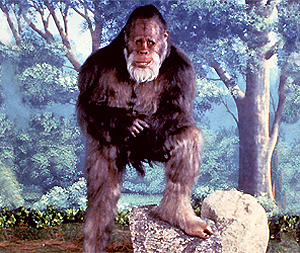
For example, I’m sure you caught the photo on the news of the Bigfoot slumped over in a deep freezer. Didn’t it look exactly as you want a Bigfoot to look? Somebody may as well have stolen a costume from that horrible 1987 movie starring John Lithgow. We all have a Bigfoot Standard Image in our minds. We have one for the Loch Ness Monster, one for Jesus, and one for Miss America. In my opinion, we may see objects in real life, but former images (as in the Bergson quote) sneak in and lay all over our perception, in the way that my grandma placed a sheet over the couch when the grandkids were visiting.
Back to what I hinted at earlier – any belief submits to subjectivity. I may not believe in ghosts, but even in this non-belief, I am throwing sensory information, what I’ve seen of silly reality TV shows, what I’ve read of literature, and my ghostless childhood, all into a consciousness processor. A conscioussor (that is horrible). My non-belief is as arbitrary as that of the Texan woman (in the above-cited article) who thought some mangy dog was Chupacabra!
Lately I have stumbled across a lot of vegan literature. I have one friend who is a confirmed vegan, and another who is vegetarian. Many artists I admire also claim to shun food derived from animals.
Today I got an email from Saul Williams (no...not to me personally...I'm just on the list) that spent a lot of time discussing the use of "List of Demands" in the Nike campaign, the responsibility we have as Americans, and veganism, respectively. While he says many good things about his Nike decision, and many good things about our American duty to the world (check out this quote: "The idea that might is right, that we demonstrate our power with aggressive force is great for football teams, but hardly the best idea for a country whose running source of pride has historically been the evidence of our collective imagination: our music; our films; our amusement parks; and the technology we create to share it"), what I would like to focus on are his statements about eating animals. I've pasted a good chunk of it not because I agree, necessarily, but because I enjoy his writing:
I am sometimes hesitant about making a big deal about my vegan diet, as I have considered it a personal choice worth little discussion. Yet more and more, I have found myself attempting to encourage people who ask me where I find my inspiration, or what issues do I find important, or how can we curb warfare and violence to consider what we ingest. A story was recently recounted to me of a popular TV chef who chose to raise little piglets on his show to insure that they were fed organic food and not injected with chemicals (as is the practice on most factory farms), all for the sake of fattening them up for their slaughter and another primetime recipe. Yet, the time that this chef spent with these pigs taught him a valuable lesson (more valuable for the pigs, no doubt). What he learned was how intelligent pigs are. In fact, in recent times, it is common knowledge for most that pigs are arguably more intelligent than "mans best friend" and companion, the dog. For our chef, this meant switching gears and realizing that he could not consciously kill this intelligent animal, that it would constitute a murder as brutal as slicing your fluffy pets neck and watching it writhe and bleed to death, or sticking an electric prod up its ass and electrocuting it, if the fur or skin is of value…
It may seem like I have just taken a turn to the graphically extreme, I wouldn't want to make you "lose your lunch", but these are the common practices perpetuated by the factory farm industry on millions of animals a day, in the name of your breakfast lunch and dinner. And, no, I'm not simply talking about pigs, but also cows, chickens, turkey, horses (that's right horses. Everyday), and fish. Everyday, our species participates in the mass genocide of other species without care or concern or even questioning whether the violence that we ingest and condone plays any role in our apathetic support of the war machine we have become. How is it that we as human beings can represent both the highest and most developed and lowest and least concerned forms of intelligence of any living species? Are we simply glued to age-old barbaric traditions that cloud our senses and render us inhumane in our dependence on comfort foods and practices? Is our dependence on foreign oil the only thing we need to curb? What about not so foreign species?
Some might argue that artists are a race or species apart from the common person. Yet we all identify with the teachings of Gandhi, the genius of Einstein, the art of Leonardo Da Vinci, Picasso, Rembrandt and the talent and compassion of living artists like Alice Walker, Will Smith, The Mars Volta, Dead Prez, Prince and countless others. Some of us choose to emulate their styles, their fashion, their career choices, but why not their diets? If our brightest most celebrated stars all have this one thing in common why are we so slow in connecting the dots for ourselves? Perhaps the biggest issue at hand is not what our cars run on, but essentially what do we run on? The fact is that factory farms are the number one users of crude oil, not cars. That's basically what it takes to kill approximately one million chickens per hour (just in the US). More than half of our water supply goes to feed animals being fattened for slaughter. The methane gases that contribute to global warming are produced majorly by cow farts in factory farms, not to mention the amount of fossil fuels needed to create just one pound of beef.
Yep. You doing the math? Basically if we shifted our compassion towards animals, the domino effect would heal the planet. We'd no longer be cutting down rain forests to create more space for cows to graze, we'd stop depleting the ocean of the necessary (keyword: necessary) food chains that our eco system depends on, diseases including many cancers, heart disease, obesity, and others which find their root in the food/toxins we ingest would slowly disappear as would our taste for violence.
Alright, so the last bit about diminishing our taste for violence is way utopian, but he makes good points. My response to animal rights activists was always, "What were the Inuits going to survive on, snow and seaweed?" But this argument doesn't hold very well, since the Inuits make up a small percentage of the world population, and most people these days have access to plant-based food.
So here's a better argument: Why aren't poor people vegetarian or vegan? The answer is obvious. Even if they could afford the lifestyle, it's doubtful that most of them have enough time or energy to fix themselves (and their families) soy-based food. It's true that a lot of poor people in some African and Asian countries are traditionally vegetarian or vegan, but they are also farmers and have ready access to vegetables. Your average poor American lives in an apartment, works most of the day, and doesn't have the willpower to find (and pay for) the grocery store. As a result, the survey says that being vegetarian or vegan is directly related to being white, educated, and somewhat wealthy.
A few weeks ago, I saw that the mayor of Los Angeles placed a ban on any new fast food restaurant entering the east side of the city. A short interview on CNN showed a local woman saying, "There is no whole foods here. We have no Trader Joe's. I have to drive through traffic to the other side to get fresh produce." There you have it.
I am in complete agreement that conditions need to be changed for the animals who are queued up for slaughter. I'm also in agreement that the drive for meat production places an enormous stress on the environment. But trying to convince omnivores that they're participating in murder ain't gonna do shit, because they don't care. Sad but true. Similarly, the small percentage of educated white vegans isn't going to clear the air of cow farts and factory pollution. I think the only chance animal rights activists have is to create public awareness that centers on the effects of meat on the body and the earth. Maintain a "selfish" campaign, and learn from politicians: Talk only of the issues people are concerned about -- their blood test results and their grandchildren's air quality (although even this is debatable).
Despite all this, I do love Saul Williams, and he just came out with a music video for "Convict Colony" (which was the real reason for the e-mail; don't you love muddled motivation?)
Curious people can feed a dollar to a machine and peer through a window to see a robotic SpongeBob SquarePants tied down, saying, “It doesn’t Gitmo better!”
I highly doubt that Steve Powers is going to get his point across with a cartoon character at Coney Island. If anything, he is allowing people to distance themselves from the act of torture (re: cartoon characters in an amusement park versus the actual tortured people in the actual GuantanamoBay facility), thereby taking waterboarding (which becomes a symbol for all torture, since it’s the only technique in the news) less seriously.
For example, Theodor Adorno, a music sociologist and philosopher, spoke out against war protest songs in the 1960s because he claimed it made the horrors of war more tolerable. And when you consider how War becomes a generational marker (my father was in the navy during Vietnam, my grandpa was a bomb-diffuser in WWII, etc.) then any anti-war movement also becomes a chapter in one’s life yearbook.
When I think of artists using cartoon figures, I think of Ron English’s billboard paintings a decade or so ago. He used McDonald’s cartoons, Disney characters, and other cartoonish figures to send a message about injustices and addictions that feed big business. He also staged live performances, such as having a woman get a make-believe abortion with a clothes hanger and bleeding all over a billboard, in front of a crowd of people. How are his methods different from Steve Powers’? Did English’s efforts make the horrors of pro-life rhetoric, big tobacco companies, and fast food addiction any less serious? Not in my mind. Since Powers built this “attraction” in an actual amusement park, the Waterboard Thrill Ride is part of Coney Island. On the contrary, English risked getting arrested every time he took over a billboard. Powers is actually making money off of this “ride.”
So Steve Powers is not really speaking out against GuantanamoBay or the torture of prisoners. He’s not risking anything. Instead, I believe he is securing his place in the anti-war yearbook and making some money at the same time. What’s worse, his work may actually result in opposite effects from what he intended, distancing people from what is going on every day, even more.